Business Phone System: Local, Toll Free, or International?
Establishing a business phone system is a simple process until you get to the real choice: what kind of number will be your business? Local, toll free, and international numbers send different signals to callers, and each is suitable for a different phase of business development. One of the most frequently made early blunders business owners make when constructing a business phone system is picking the wrong combination is one of the easiest to avoid once you understand the jobs each option is actually intended for.
This guide explains the different messages that can be sent to customers with local phone numbers, toll free numbers, and international numbers, their costs, and how to merge them together to create a business phone system that represents where your business is today. We’ll even discuss its real-world aspect as well, number porting, call routing, and how the proper setup enables business communication as a company grows, all along the way.
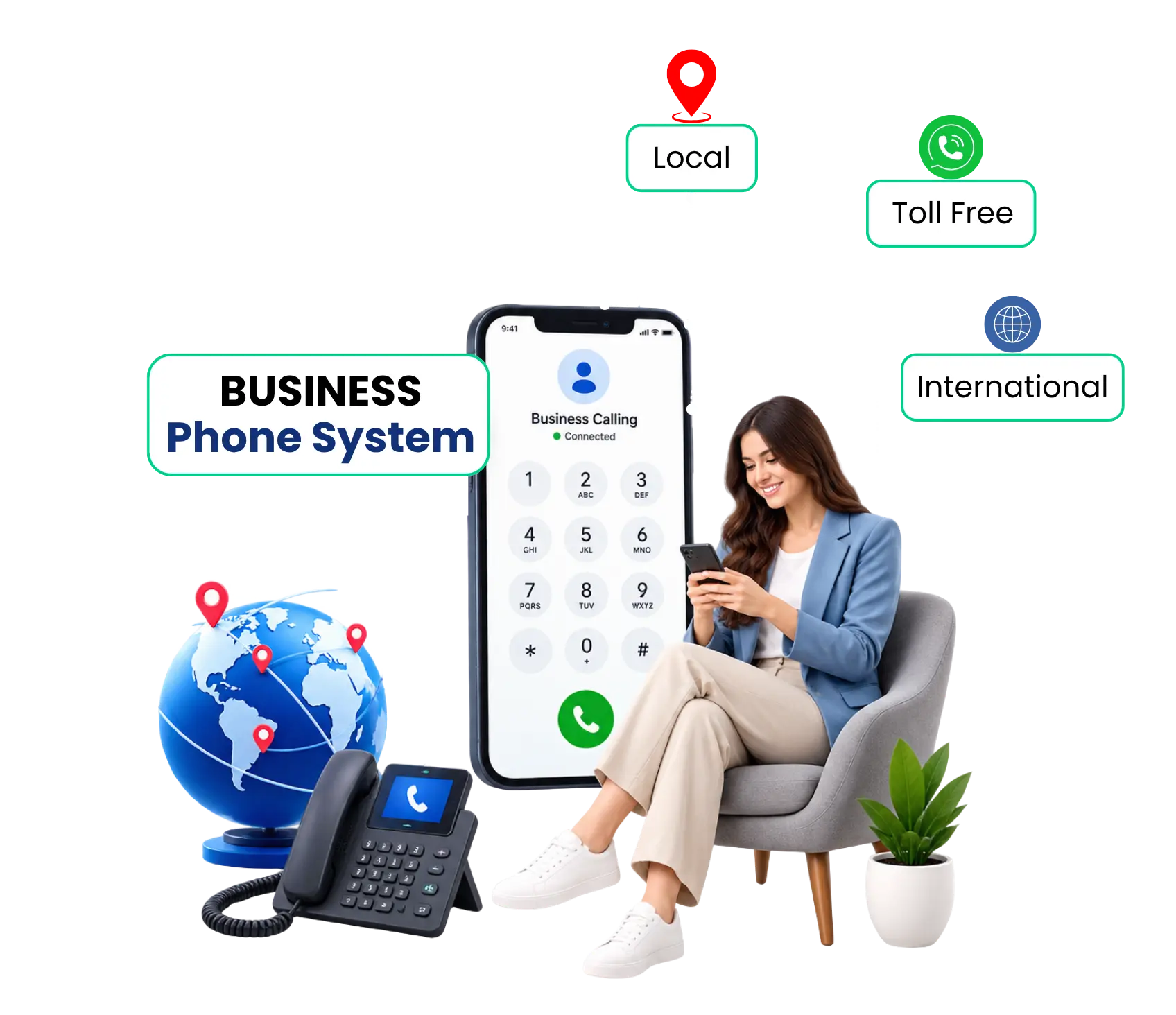
When you’re setting up your first line, or redeveloping your current one as your company expands, the main point is to choose numbers that reflect the way you’re being discovered by your customers, not how you’d like to be. An effective business phone system will save money early on and avoid the later cost of a rebuild when call volume and geography have changed.
A Local Phone Number Can Say a Lot About Your Business
A local phone number has an area code that is associated with a particular city or region. It sounds local, it is a local call, and it is normally the quickest and most cost-efficient number to have inside any business phone system.
The Trust Factor
A popular area code is instantly comforting for many customers. It means it is close, accessible, and a part of the community, which is important in customer trust-driven businesses and industries where relationships are the key.
Who It’s Best For?
- Service companies serving an area that is just one city or neighborhood.
- Businesses attempting to connect with a local client base.
- For remote teams who wish to have a local presence in their local market.
Above are the reasons this type of number is best suited for.
Real-World Examples
- Most of the people who call a dentist’s office or a salon call from the local area.
- The local credibility that a local phone number offers is an advantage to a regional law firm within a single geographic market.
- A startup that is just entering a new market can select one specifically as a trust indicator, even if it has not expanded to other markets.
Setup Speed
This type of number generally doesn’t have any verification delays, making it the fastest to get up and running in a business phone system. If your clients are all in one location, it’s often best to begin with call routing, as it can typically be set up on the same day.
How International Numbers Can Open Your Doors to the World
But international numbers address a totally different issue: making a presence in another country without costing long-distance rates for the customers to reach you.
What is the point of this coverage?
They are most important for:
- Companies with international customers.
- Teams that require a local point of contact in a particular country.
- Marketing and sales activities conducted at a local level for a foreign market.
- Then support teams receive customers’ calls from other time zones.
This is the barrier that it removes
This is an area of a business phone system that is typically overlooked, but it deals with a genuine challenge. When customers are just as curious as they are about a product or service, but deterred by the fear of costly overseas calls, those languages that are not in their native tongue are the ones that quietly lose customers.
Common Use Cases
- A company that ships to a number of countries, including e-commerce ones.
- A help desk that receives calls from multiple locations and time zones. A help desk that receives calls from multiple time zones and locations.
- An overseas team. seeking a local contact number for recruiting talent overseas.
Local vs Toll Free vs International Numbers: Cost Comparison
It is a delicate consideration of technical capabilities that leads to choosing the appropriate solution. Not every provider can be as reliable, compliant, or integrate.
1. Price at a Glance
Best local phone number: Least expensive and easiest to set up.
Toll free numbers: Moderate cost as the business will cover the call cost.
International numbers: The cost depends on the number of countries included.
Two way SMS will make sure that your customers are able to directly respond to your texts. This capability promotes chat marketing, support questions and confirming appointments.
2. Setup Time
Local and toll-free numbers are typically ones that turn on very fast. International numbers, however, may need country-specific authentication and legal standards, and, if you aren’t changing the number but moving an existing number, also allow for a few days to a few weeks for the number porting process, depending on the carrier, so it’s best to plan accordingly rather than as an afterthought.
3. Budget Strategy
You also need to take the budget into account here. A startup that doesn’t have a big budget may only expand the lines into another region, while an established company going into multiple markets may expand the lines all the way to the country and international levels from the start. There’s no right or wrong; it’s a matter of where the business phone system must be operational now versus where it can grow over time and budget.
4. Side by side
Local Numbers
- Signal: Regional
- Who pays: Customer
- Cost: Low
- Best stage: Just starting
Toll-Free Numbers
- Signal: National
- Who pays: Business
- Cost: Moderate
- Best stage: Scaling nationwide
International Numbers
- Signal: Global
- Who pays: Customer
- Cost: Scales with reach
- Best stage: Expanding abroad
A solid business telephone system often incorporates all three of these: a local phone number for the local market, toll-free numbers for national campaigns, and international numbers when the business starts expanding overseas.
Common Mistakes When Choosing Numbers for Your Business Phone System
When a business implements its number strategy for the first time, a few common errors tend to emerge:
- Selecting toll free numbers before there is a national customer base for them to serve.
- Not having a local phone number when customers already have one in another region.
- Assuming that international numbers required for verification are less than what they are in active campaigns.
- Assuming that the number setup is fixed and cannot be changed, whereas it is evolving.
Early avoidance of these pitfalls will save time and prevent rework later, particularly as marketing and sales begin to bring customers outside the service area.
How a Virtual Phone Number Ties It All Together
Most modern suppliers offer all three types of numbers on a single virtual phone number, not individual physical phone numbers. A virtual phone number exists in the cloud, and a business phone system can have a new phone line for nationwide marketing or a new market without hardware or site installation.
What changes with Cloud Delivery?
This flexibility makes it possible for a rapidly expanding company to operate various numbers side by side. With the number mix changing over time, the underlying infrastructure remains uniform, even when calls are routed to any device, from any location.
It Matters for Growing Teams
It’s what makes it possible for a business to test a new market without spending a ton of money, such as the addition of coverage in a new country, without having to sign a long-term contract with a local carrier. For distributed or remote teams, this is even more important, as they can receive business calls on any device without being dependent on a desk phone at a specific location. Many setups also allow for CRM integration, meaning that any call will be automatically logged in the right contact, no matter which number it’s connected through. Providers such as Dialinger can integrate this flexibility into the application right away and have local, toll free, and international numbers working on the same dashboard, rather than on separate systems.
Selecting the appropriate numbers for your growth stage
Be realistic in matching the type of number to the business you are in today, not the business you imagine you will be in a year. Too much coverage is too early and is a waste of money; too little coverage means your customers are at a disadvantage trying to get to you.
Quick Checklist
- Customer in one region: most customers require only a regional number.
- They have customers all over the country: national coverage makes sense.
- Active business activities abroad: international coverage is a worthwhile investment.
- More than one number type: a combination of all three.
Matching Stage to Investment
Usually, a business has only one local line when it is based in a particular area. A business with national advertising can benefit from having a toll free presence. If your business has operations in other countries, then special coverage in those markets will be worthwhile, as it will eliminate one of the real barriers to customers calling from overseas. None of these is a permanent option; they are supposed to grow with the business.
A simple way to check your coverage
If you find you are not sure what you require your system is for at the moment, do this exercise: Go over your incoming calls for the last month and record the places they came from. Most calls are local, so one regional line will probably do the job. If a significant percentage is from other states or countries, then it’s an obvious indication that the coverage should be expanded.
Signs It’s Time to Expand
- Customers call with a reference to long-distance charges.
- Marketing initiatives are going beyond your local market
- Support calls are received from a greater number of unknown area codes or countries.
- Sales calls are not made because prospects are not sure who to call
Keep It Reviewed
Review this review regularly. Successful expansion can take a business into new markets, and an organization designed for the customers of last year can turn out to be an unexpected roadblock. The art of obtaining the right number mix is not about impressing; it is about making it the easiest possible for customers to reach you.
When you review real call data on a regular basis, it’s the easiest way to stay in sync with business growth. First, meet your customers’ needs today, then leave space for additional coverage in the future and let real usage, not assumptions, inform all subsequent choices
How Dialinger Makes This Easy to Get Right
It’s not just about selecting a combination of numbers; it’s also about having a system that allows you to switch that combination up without having to start all over again. This is where Dialinger comes in.
One Platform, All Number Types
Unlike juggling multiple vendors or contracts for different types of numbers, Dialinger has the ability to provision local, toll free, and international phone numbers through a single dashboard as coverage requirements evolve. Call routing, CRM integration, and reporting are all in one place rather than across tools.
Designed to Grow with You
No new hardware, no installation on site, no long negotiations with carriers, it takes minutes to add a toll free line or an international number for that new market you’re about to enter.
After the setup, support is there to stay
From number porting timelines to country-specific verification for international lines, Dialinger team takes care of the aspects that businesses often overlook to ensure nothing gets missed while setting up or expanding.
A System That Grows with the Business
From a single local line to multiple countries at once, Dialinger can be configured to handle every step in this guide, and can be configured without a rebuild with every growth of the business. It’s built on the way such communication takes place in the real world: across devices, across time zones, and across expanding teams. So, it’s worth trying out if you’d like to get the number combination right the first time.
Frequently Asked Questions
What is a business phone system?
A business phone system helps companies manage calls and customer communication professionally. It can include call routing, voicemail, call forwarding, and virtual numbers.
What is the difference between local, toll free, and international numbers?
Local numbers create a presence in a specific area, while toll free numbers make calling easier for customers. International numbers help businesses connect with customers in different countries.
Which phone number is best for a small business?
A local number is ideal for businesses targeting a specific market or region and Toll free or international numbers work better for broader customer coverage.
Can I use a business phone system from anywhere?
Yes, cloud based business phone systems allow teams to make and receive calls from anywhere. All you need is a compatible device and a reliable internet connection.