On-Premise vs Cloud VoIP: Which Business Phone System Is Right for You?
Choosing a business phone setup used to be simple. You bought a big box, tucked it into a closet, and hoped it kept working. Today there are two real paths, and the On-Premise vs Cloud VoIP debate comes up in almost every conversation about business phones. Both let you make calls over the internet instead of old copper lines, so the technology itself is not what separates them. The real difference is where the phone system lives and who takes care of it.
That one detail changes a lot. It affects how much you pay at the start, how quickly you can add new people, and how your team works when they are not sitting in the same office. It also decides who gets the call when something breaks on a busy Monday morning. Some businesses love having full control of their own equipment, while others would rather hand the heavy lifting to a provider and get back to work.
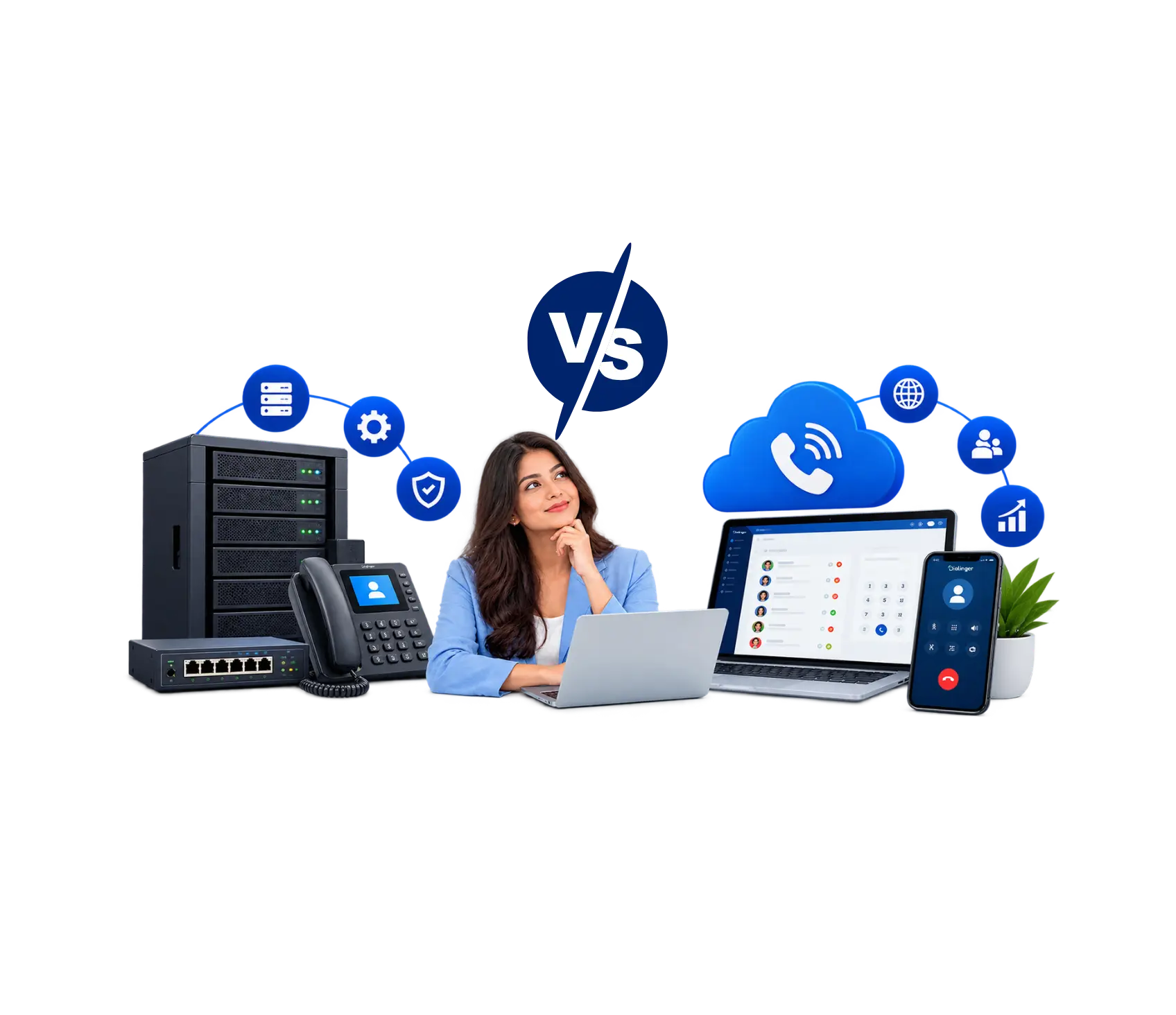
What Is an On-Premise VoIP System?
An on-premise setup means the phone server sits inside your own building. You buy the hardware, install the software, and your team or an outside technician keeps everything running. Calls still travel over your internet connection, but the brain of the system, usually a PBX server, stays in your office.
Because everything belongs to you, you control the settings, the security, and the data. The catch is that you also carry the cost and the work. If the server fails or a part wears out, fixing it falls on you. Many larger companies with strict rules or a full IT team still prefer this route for exactly that reason.
What Is a Cloud VoIP System?
A cloud setup moves the phone server out of your office and into the provider’s data centers. You pay a monthly fee, log in through an app or browser, and the provider handles updates, maintenance, and hardware. Your team can make and take calls from a laptop, mobile phone, or desk phone wherever there is internet.
Adding a new employee often takes just a few minutes. Services like VoIP calling work this way, so there is no equipment to buy before you start.
Key Difference Between On-Premise VoIP and Cloud VoIP: On-Premise vs Cloud VoIP
Here is a side by side look at On-Premise vs Cloud VoIP across the points that matter most in daily use.
Point | On-Premise VoIP | Cloud VoIP |
Where the system lives | Server inside your office | Provider’s data centers |
Upfront cost | High, since you buy hardware and licenses | Low, often just a monthly plan |
Ongoing cost | Maintenance, power, and IT time | Predictable per user fee |
Setup time | Weeks, sometimes longer | Hours or a few days |
Maintenance | Handled by your team | Handled by the provider |
Scaling | Slow, needs new hardware | Quick, add or remove users anytime |
Remote work | Harder, needs extra setup | Built in, works from anywhere |
Control | Full control over everything | Shared with the provider |
As the table shows, On-Premise vs Cloud VoIP is mostly a trade between control and convenience. On-premise gives you more of the first, and cloud gives you more of the second.
We'd Love to Hear From You
Ready to expand your business globally?
Fill out the form below, and our team will help you choose the perfect number.
Benefits and Limitations of Cloud VoIP
Benefits
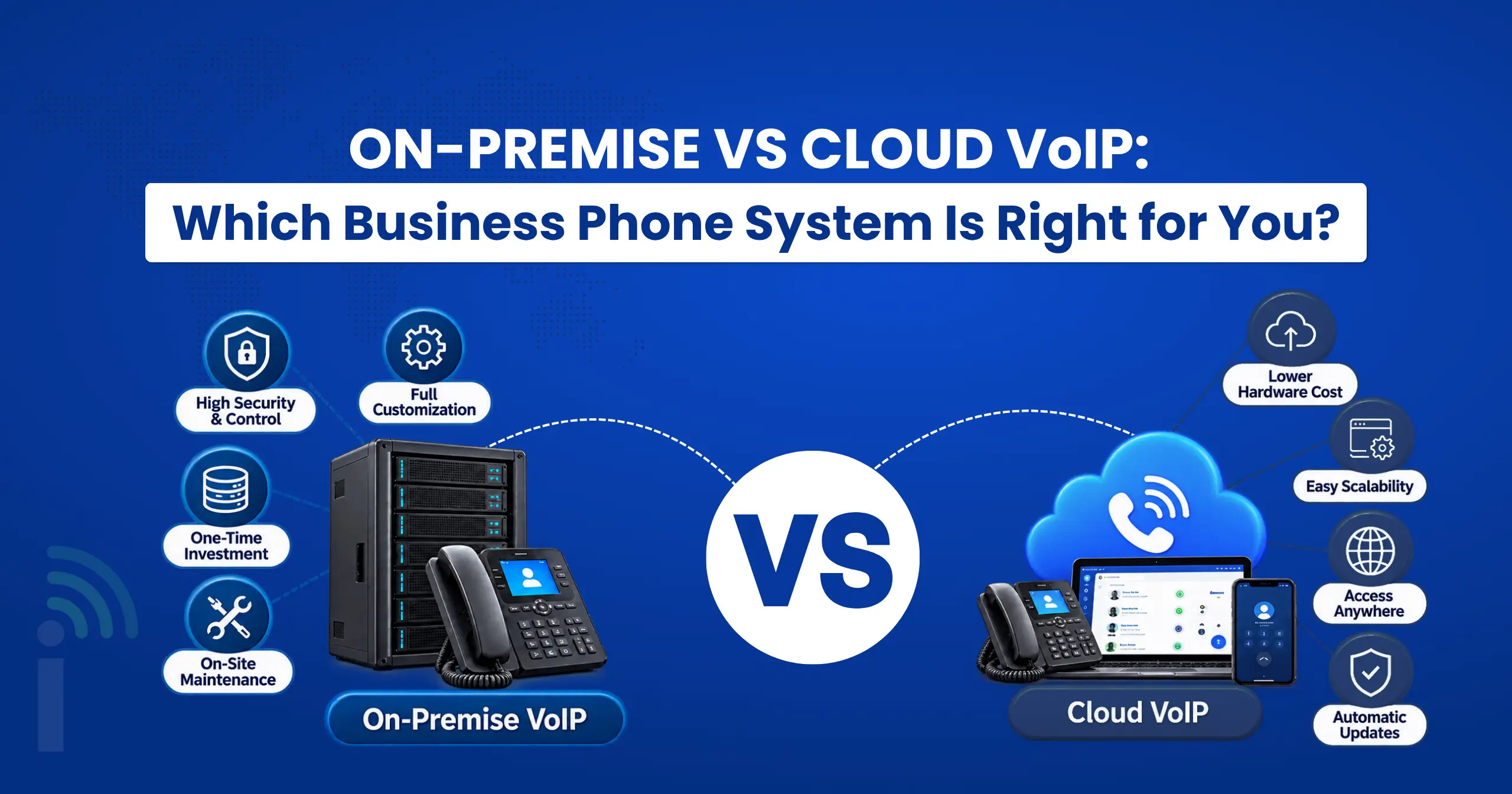
- Lower upfront cost: You don’t have to buy expensive servers or phone lines. You can just start with a small monthly plan and save your money for other things that matter more.
- Easy to scale: Hiring ten people for the holiday rush? Add ten seats in minutes. When the rush ends, remove them just as quickly.
- Great for remote and hybrid teams: Everyone gets the same business number and features on their own device, whether they sit at home, in an office, or in another country.
- Better Updates and backups: The provider’s job is to fix bugs, add features and distribute the service over multiple data centers, making sure that one failure does not bring you down.
Limitations
- Needs a steady internet connection: A cloud VoIP system lives and dies by your bandwidth. If your internet is weak or drops often, call quality will suffer.
- Monthly fees never stop: The cost is easy to manage at first, but over many years the subscription adds up.
- Less control: You depend on the provider for uptime, features and updates, and you cannot do everything to your liking.
- Quality varies between providers: Some are excellent and some are not, so reading reviews and testing with a trial is worth the effort.
Benefits and Limitations of On-Premise VoIP
Benefits
- Full control: You decide how the system is set up, where data is stored, and who can touch it. That matters a lot to businesses with unusual needs.
- Possible long term savings: For a large, stable team that will not change for many years, owning the hardware can cost less than paying a subscription forever.
- Internal calls keep working: Since the server is in your building, calls between desks can often continue on the local network even if your internet goes down.
- Stricter Rules: If there are strong requirements regarding the location of the data, it’s easier to comply with these rules if the data resides on your own premises.
Limitations
- High upfront cost: On-premise VoIP system isn’t cheap. You have to pay for servers, phones, licenses, and installation before you can even place your first call and that bill can get pretty big.
- Needs skilled people: Somebody has to patch, monitor and repair the system which means hiring staff or paying a contractor.
- Hard to scale:New users or a new office typically means more hardware. More licenses. More waiting.
- Remote work is awkward: Connecting home workers securely takes extra tools and settings, and it rarely feels as smooth as a cloud app.
Factors to Consider When Choosing Between On-Premise and Cloud VoIP
Before you settle the On-Premise vs Cloud VoIP question, run through these six points honestly.
Budget
Think about both what you can spend today and what you will spend over five years. Cloud is easier on the cash flow up front, but on-premise may look better on paper over the long haul.
Team size and growth
A fast growing company changes its headcount often, and cloud handles that without a fuss. A steady team in one building has more reason to consider owning its hardware.
Remote or hybrid
work
If people work from home, travel, or sit in different cities, cloud saves you a lot of headaches. If everyone stays in one office all day, this point matters less.
IT Skills
An on-premise VoIP system needs someone who knows what they are doing. If you do not have that person, you will end up paying for outside help or living with problems.
Internet quality
As with any Cloud VoIP system, you’ll need reliable bandwidth, so test your connection before you commit. If your internet is flaky and can’t be fixed, take that into account.
Security and compliance
Check the rules that apply to your industry. Reputable cloud providers use strong protection, but some businesses must keep data in-house, and that can settle the question quickly.
Score each point for your own business, and the On-Premise vs Cloud VoIP answer usually becomes clear on its own.
Which One Is the Best VoIP System for You?
There is no single winner, but there is a pattern. For most small and growing teams, a cloud VoIP system is the safer pick. It costs less to start, it is quick to set up, and it supports remote work without extra effort. You also skip the stress of managing servers, which is a big relief when you have a business to run.An on-premise VoIP system still makes sense for a smaller group of companies. Large organizations with strong IT teams, strict data rules, or a long stable setup may get real value from owning the hardware. If that sounds like you, the higher cost and extra work can be worth it.
If you are still unsure, start with a short trial of a cloud service and see how it feels with real calls. You can check the plans on the Dialinger or look at its cloud PBX solution to see what a modern setup includes.In the end, On-Premise vs Cloud VoIP is not about which option sounds more modern. It is about which one fits your budget, your people, and the way you work every day. Pick the one that removes the most friction, and your phones will stop being a problem and go back to being a tool.
Frequently Asked Questions (FAQs)
Which is best for a scalable business?
Cloud is the better choice. You can add or remove users in minutes without buying new hardware, so it keeps up easily as your team grows.
What are the main differences between a cloud VoIP system and an on-premise VoIP system?
A cloud VoIP system runs in the provider’s data centers for a monthly fee, while an on-premise VoIP system sits in your office and needs you to buy and maintain the hardware. Cloud is cheaper to start and better for remote teams, and on-premise gives you more direct control.
Which system is more reliable during internet outages?
On-premise has a small edge, since calls between desks can keep working on the local network. Cloud depends on your internet, but call forwarding to a mobile number or a backup internet line keeps it running.
Do cloud VoIP systems offer better control and security?
Not better control, since on-premise gives you more of that. For security, good cloud providers often match or beat what a small business can build alone, thanks to encryption and constant monitoring.