What Is Predictive Dialer Solution? How it Works & Benefits
If you’ve ever watched a sales rep spend half an afternoon listening to ringtones, voicemail greetings, and “this number is no longer in service,” you already know the problem. Talk time pays the bills, and most of the workday gets eaten by everything else.
A predictive dialer solution is built to fix that. It places the calls for your agents, throws out the dead ends, and connects a rep only when a real person picks up. An automated predictive dialer used to be something only huge call centers bothered with, but plenty of small outbound teams run one now. This solution covers what it is, how it works, where it helps, and what to check before you commit to anything.

What Is a Predictive Dialer Solution?
It’s a calling platform that dials several numbers at once from a contact list, guesses when an agent is about to be free, and sends the live answers straight to that agent. The “predictive” part is the clever bit. The system keeps an eye on average call length, answer rates, and how many agents are sitting idle, then speeds up or slows down its dialing to match.
Picture a restaurant host who seats guests a minute before a table actually opens. Get the timing right and nobody waits, and no table sits empty. Get it wrong and there’s a crowd at the door, which in calling terms means abandoned calls. We’ll come back to that.
You’ll see these tools in outbound sales, collections, appointment reminders, surveys, and lead follow-up. Basically anywhere there’s a long list and not enough people to work it.
How Does a Predictive Dialer Solution Work?
Under the hood it’s a loop with six moving parts:
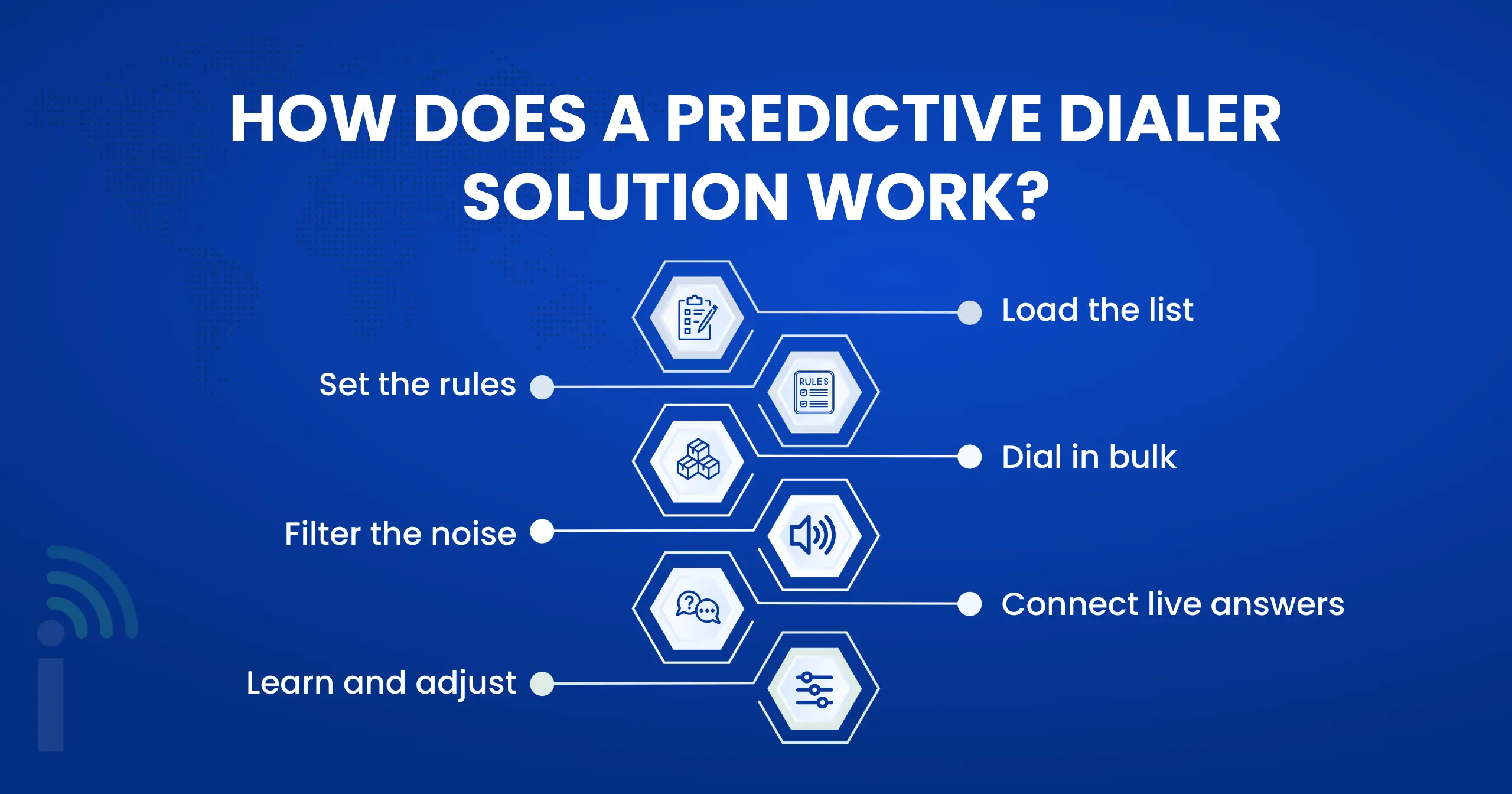
- Load the list: You upload contacts as a CSV or sync them from your CRM. A messy list wastes more time than any algorithm can save, so clean it first.
- Set the rules: Calling hours, retry limits, caller ID, and how aggressively the system should dial all get decided here.
- Dial in bulk: Instead of one call per agent, the dialer launches several at once, based on how many agents are free.
- Filter the noise: Busy tones, disconnected numbers, fax lines, and voicemail get detected and logged without ever touching an agent.
- Connect live answers: When a human says hello, the call drops onto a free agent, ideally with the contact’s record already open on screen.
- Learn and adjust: The algorithm keeps recalculating from fresh answer rates and talk times, so the pace follows what’s really happening on the floor.
Every outcome gets logged along the way, which is what makes the reporting useful later.
Core Features of Predictive Dialer Software
Plenty of predictive dialer software looks identical in a demo. These five features are where the real differences show up.
Adaptive pacing with abandonment control
You want a hard limit on how many answered calls can go unattended, plus the ability to dial the pace back when your team is short-staffed or on break.
Answering machine detection
Good detection keeps agents away from voicemail greetings. Poor detection hangs up on real people, which is worse than having no detection at all.
CRM integration
The agent should see the name, history, and last note before saying a word. Nobody likes opening a call with "so, remind me who you are?"
Call recording and live monitoring
Managers need to coach in real time, and compliance teams need a record of what was said.
Predictive Dialers Improving Telemarketing
Predictive dialers make telemarketing faster and smarter. They automatically call multiple numbers at once and only connect agents when a real person answers. This cuts down on idle time and helps teams reach more prospects in less time. The result is higher contact rates and more productive sales conversations.
We'd Love to Hear From You
Ready to expand your business globally?
Fill out the form below, and our team will help you choose the perfect number.
Auto Dialer System vs. a Full Predictive Dialer Solution
People use these terms interchangeably, and they really shouldn’t. An auto dialer system is the broader category: software that dials numbers so your agents don’t have to. Predictive dialing is one smarter, more demanding version of that idea. Here’s the quick comparison.
Feature | Auto Dialer System | Full Predictive Dialer |
Dialing method | One call at a time, or a simple queue | Several calls per available agent |
Agent matching | Agent triggers or waits for each call | Algorithm forecasts availability and routes live answers |
Idle time | Moderate, agents wait between calls | Very low when tuned well |
Best for | Small teams, high-touch conversations | Larger teams with big lists and heavy volume |
Setup and risk | Simple, light compliance exposure | More tuning, tighter abandonment rules to manage |
If your reps need a minute of prep before each conversation, the simpler option often wins. If speed and volume matter most, go predictive.
Advantages of a Cloud Predictive Dialer Over On-Premise Systems
On-premise dialers had their moment. You bought servers, hired someone to babysit them, and hoped nothing broke on a Monday morning. A cloud predictive dialer skips most of that headache.
Faster Setup
Sign in, import contacts, start dialing. We’re talking days rather than months of installation and phone-line work.
Lower upfront
cost
There’s no hardware to buy and no maintenance contract to renew. You usually pay per seat, which is far easier on a small budget.
Works from
anywhere
Remote and hybrid agents only need a browser and a decent headset, so your team isn’t chained to one office or one city.
Easier scaling and
updates
Adding ten seats for a seasonal push takes minutes. New features and fixes arrive automatically instead of through an upgrade project nobody wants to own.
What an Automated Predictive Dialer Does?
In plain terms, an automated predictive dialer takes the repetitive parts of outbound calling off your agents’ plates. It dials, waits, listens, filters, and connects, all without anyone touching a keypad. It also schedules callbacks, respects your calling windows, and updates records after each attempt.
What it doesn’t do is replace the person on the call. The conversation is still human. The dialer just makes sure that human spends the day talking instead of waiting around for someone to pick up.
Key Benefits of Using a Predictive Dialer Solution
Moving to a cloud call center for ecommerce brings a handful of advantages that matter a lot once a store starts scaling.
- Reduced initial expense: No physical equipment or server space required because all is done through the provider’s infrastructure.
- More rapid scale-up for sales events: When an agent is added during a sales event, such as Black Friday or a flash sale, it typically takes minutes rather than weeks to scale up.
- Remote team support: Agents have the ability to work from any location with access to a reliable internet connection, resulting in a much larger talent pool.
- Improved reliability: A dependable cloud call center for ecommerce spreads its services across multiple data centers, which ensures that there is no single point of failure.
- Automatic updates: You don’t need an IT team to manually install new features.
- Lower long-term costs: Subscription based pricing tends to work out cheaper than maintaining aging on-site equipment over time.
A Quick Word on Compliance
Speed comes with responsibility. Many regions limit how many answered calls a dialer can abandon, and rules like the TCPA in the US cover consent, calling hours, and do-not-call lists. Penalties can be steep. Check what applies where you operate, and when in doubt, ask a lawyer rather than a sales rep.
How to Choose the Right Predictive Dialer Solution
Shopping gets easier once you know what to ask. Start here:
- Check compliance tools first: Look for do-not-call scrubbing, calling-hour controls, consent tracking, and a way to cap abandoned calls.
- Test it with a real list: Any decent predictive dialer software offers a trial or demo. Run actual contacts through it instead of trusting the slide deck.
- Decide on cloud or on-premise: For most teams, a cloud predictive dialer is the safer bet unless strict data rules say otherwise.
- Look at integrations: If it doesn’t talk to your CRM, your agents will end up copying notes by hand, and that kills the time savings.
- Ask about call quality: Latency and choppy audio ruin conversations. Find out how routes are monitored.
- Read the pricing carefully: Per-seat fees, per-minute charges, and add-ons stack up. Get a total for your real volume.
- Plan for support: On launch day at 9 a.m., you want a human who actually answers.
Common Mistakes Teams Make
A few things go wrong again and again. Teams dial too aggressively on day one, then wonder why customers complain about silent calls. They load old, unscrubbed lists and blame the tool when connect rates are poor. They skip agent training, so reps panic when calls arrive faster than expected. And they forget to review call recordings, which is where most of the coaching gold hides. Start conservative, scrub your lists, train people, and review calls weekly.
A predictive dialer solution isn’t magic. It’s a pacing engine that keeps your agents talking to real people instead of staring at a ringing line. Pick well and you get more conversations, steadier data, and a calmer team. Pick badly and you get abandoned calls and compliance headaches.
So start with a clean list, a clear compliance plan, and a trial run with real predictive dialer software before you commit. Your reps’ time is the most expensive thing in the room. Spend it on conversations.
Where Dialinger Fits In
If you’re leaning toward a cloud predictive dialer, Dialinger is worth putting on your shortlist. It’s a cloud-based communication platform with an auto dialer system built for faster, smarter outbound calling. If your team prefers working through contacts in a set order, the power dialer software page explains that approach too.
Around the dialer you get the pieces that make outbound work: CRM integration, call analytics, live call monitoring, and call recording. Teams building out a bigger operation can also look at Dialinger’s call center software and virtual call center solution.
When you evaluate any predictive dialer solution, including this one, ask in the demo exactly how pacing, abandonment limits, and compliance controls work for your volume and region. A good vendor answers that directly.
Frequently Asked Questions (FAQs)
Is a predictive dialer the same as a power dialer?
Not quite. A power dialer calls one number per available agent, in order, so there’s never a surprise. A predictive dialer calls several numbers per agent and bets that most won’t be answered. Power dialing is calmer and safer. Predictive dialing is faster, but it needs more tuning.
What's an abandoned call, and why does everyone worry about it?
That’s an abandoned call. The person says hello and gets silence or a hang-up, which annoys them and is regulated in many regions. Good tools let you set a cap on abandoned calls and slow the dialing pace automatically when you’re close to it. Check the limit that applies to you.
Can a cloud predictive dialer work for a remote or hybrid team?
Yes, and that's one of its biggest strengths. Agents log in through a browser or app with a headset, so they can work from home, a coworking space, or another country. Just make sure everyone has a stable internet connection, because audio problems hurt more at high call volume.
Is an auto dialer system enough for a small team?
Often, yes. If your reps need a minute of prep before each conversation, a simpler setup keeps things calm and keeps compliance risk low. When your list and call volume grow, you can step up to an automated predictive dialer without having to rebuild your whole process.