VoIP for Education: The Phone System Schools Actually Need
Walk into almost any school office in the morning and you’ll see the same scene playing out. Three lines ringing at once. A receptionist trying to figure out if the call is about attendance, a sick kid waiting for pickup, or someone asking about the lunch menu. And somewhere in the mix, a parent who’s been on hold for six minutes and is about ready to give up.
This is the exact problem voip for education is meant to fix. Not by adding more gadgets or making things flashier, but by giving schools a phone system that actually keeps up with how a school day really moves.
Most schools are still running on old copper-line setups that were installed years ago and never really rethought since. They work, technically. But “technically working” and “actually helping” are two very different things when a parent is trying
What Does VoIP for Education Actually Change?
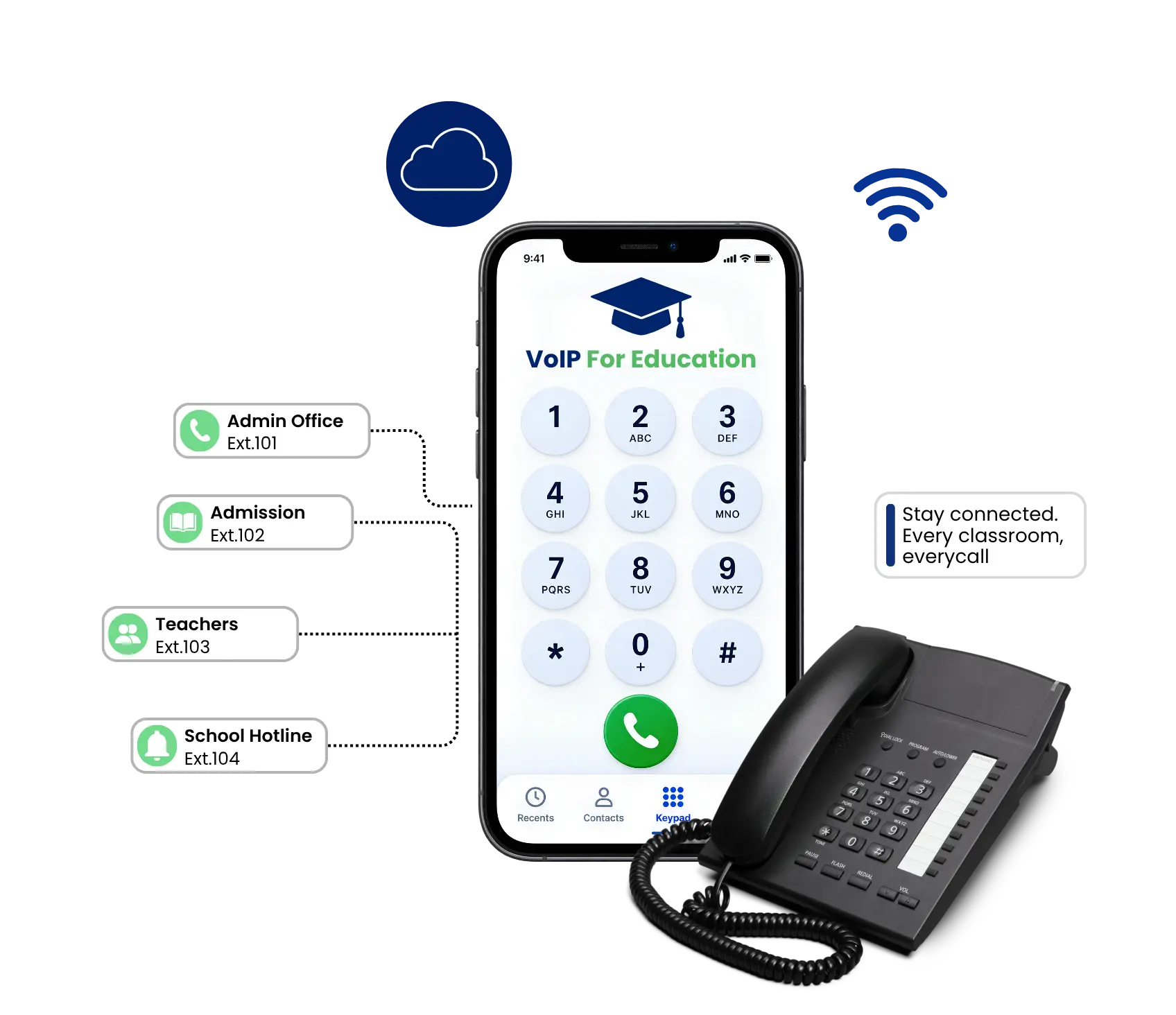
At the simplest level, voip for education means calls travel over the internet instead of old phone wiring. That one shift opens up a lot more than people expect.
A teacher on the other side of campus can be reached the same way as someone sitting at the front desk. A counselor working out of a portable classroom isn’t cut off from the main system anymore. And staff aren’t stuck physically walking room to room just to pass along a message that could’ve taken five seconds over the phone.
It’s a small technical change on paper. In practice, it’s the difference between a school communication system that keeps everyone connected and one that quietly creates gaps nobody notices until there’s an emergency and someone can’t be reached fast enough.
Why Are Schools Moving Toward a Hosted PBX for Schools Instead of Old Hardware?
Here’s where things get practical. A hosted PBX for schools basically means the phone system itself lives in the cloud instead of sitting in a server closet somewhere on campus collecting dust. No boxes to maintain, no technician visits every time something glitches, no waiting weeks for replacement parts for hardware that’s basically obsolete.
For a district juggling tight budgets and an IT team that’s already stretched managing Chromebooks, wifi, and classroom software, this matters a lot. A hosted PBX for schools means updates happen automatically in the background. Adding a new extension for a teacher who just joined mid-semester takes minutes, not a service ticket and a two-week wait.
It also scales in a way old systems never could. A school opening a new building doesn’t need to install a whole separate phone system fro
Making the Classroom Phone System Actually Useful
A classroom phone system used to mean one thing: a wall-mounted phone that maybe got used twice a year, mostly for calling the office in an emergency. That’s changing.
With voip for education in place, a classroom phone system becomes something teachers actually rely on day to day. Quick messages can go straight to a teacher’s extension without pulling them out of class. Emergency alerts can reach every classroom at once instead of relying on someone running down the hallway. And because everything runs on the same network, a classroom phone system connects directly into whatever routing rules the school has already set up for attendance, the nurse’s office, or front-desk calls.
This matters more than it sounds. When something urgent happens, a lockdown, a weather closure, a safety issue, every second spent trying to reach the right room adds unnecessary risk. A classroom phone system that’s actually built into a modern setup removes that lag entirely.
We'd Love to Hear From You
Ready to expand your business globally?
Fill out the form below, and our team will help you choose the perfect number.
What Unified Communications for Education Really Means for a District?
Once you’re dealing with more than one building, the conversation shifts. This is where unified communications for education comes in, and it’s really about tying every location together under one system instead of leaving each school to run its own disconnected setup.
Picture a district with five schools. Under the old model, each one probably has its own phone system, its own quirks, and its own blind spots that nobody at the district office can see. If something goes wrong at one campus, there’s no easy way for administration to know until someone picks up the phone and calls to complain.
Unified communications for education flips that. One system covers every building, but each school still keeps its own extensions and routing setup. District staff get a clear view across every location, while individual schools still operate the way that works best for them. Parents get the same experience no matter which campus their child attends, which is honestly what most people expect by now anyway.
What a Good School Communication System Should Actually Include?
Not every setup labeled as a school communication system is built with schools in mind. A few things separate the ones that genuinely help from the ones that just look good in a sales pitch:
Department-based routing
So a parent asking about attendance doesn't accidentally end up talking to the nurse's office.
Emergency broadcast capability
Because during an actual crisis, messages need to reach everyone immediately, not get stuck behind routine calls.
Voicemail-to-text
Since staff moving between classes all day rarely have time to sit down and listen to messages one by one.
Built-in data protection
Since a school communication system often touches voicemail and call logs tied to students and families, which means security can't be an afterthought.
Getting these basics right is really what separates a rushed rollout from one that actually holds up once the school year gets busy.
Automatic Call Distribution Helps Busy School
Anyone who’s worked a school front desk during drop-off knows the feeling, three lines ringing at once, a parent on hold getting impatient, and no real way to tell who actually needs urgent help versus who’s just asking about the lunch menu. Automatic call distribution is what quietly fixes this. Instead of every call landing on whoever happens to be free, or worse, nobody at all, it spreads calls across available staff and routes them based on what the caller actually needs.
Where Schools Tend to Get This Wrong?
Even with the right system in place, plenty of schools stumble during the switch. A few patterns show up again and again:
Switching mid-semester
Rolling out a new system while classes are in full swing almost always causes more headaches than it solves. Summer break is nearly always the smarter window.
Skipping proper staff training
Front-office staff and teachers need real, hands-on walkthroughs, not a quick email explaining where the buttons are.
Leaving emergency routing untested
This should be confirmed working before the system goes live, not discovered broken in the middle of an actual emergency.
Underestimating how many extensions are needed
Coaches, part-time staff, and seasonal positions get forgotten constantly during planning.
None of these mistakes are hard to avoid. They just require treating the switch as a real project instead of squeezing it in as an afterthought between everything else already on a school’s plate.
Why Dialinger Fits What Schools Actually Need
If you’re weighing your options, Dialinger’s education solution is built specifically around what schools and districts deal with every day: department routing, multi-location support, and a setup simple enough that you don’t need a dedicated IT specialist just to keep the lights on.
Beyond the core setup, Dialinger also covers the broader pieces schools often overlook until they actually need them, things like voicemail management and call routing that grow along with the district instead of needing to be rebuilt every time a new campus comes online. If you want to see how it fits your school’s actual day-to-day, you can book a demo and walk through it directly with the team.
At the end of the day, voip for education isn’t about chasing whatever’s newest in tech. It’s about giving schools a system that works the way an actual school day works, reachable, dependable, and simple enough for already-busy staff to manage without adding one more thing to worry about.
Frequently Asked Questions (FAQs)
What's the real advantage of a hosted PBX for schools over old phone hardware?
A hosted PBX for schools runs in the cloud, so there’s no equipment sitting in a closet to maintain. Updates happen automatically, and adding a new extension takes minutes instead of a service ticket and a long wait.
Can a classroom phone system do more than just call the front office?
Yes. With voip for education in place, a classroom phone system can receive direct messages, connect into school-wide routing, and reach every room instantly during an emergency, not just handle the occasional office call.
How does unified communications for education help a district with multiple schools?
It brings every campus onto one system while letting each school keep its own extensions and routing. District staff get visibility across every location, and parents get the same experience no matter which school their child attends.
What should a school actually look for in a school communication system?
The basics matter most: department-based routing, emergency broadcast capability, voicemail-to-text, simple dashboard controls for IT, and built-in protection for voicemail and call data tied to students and families.