Call Flow: The Invisible Map Behind Every Business Call
Have you ever called a business and somehow gotten right where you needed to without even thinking about it? That smooth experience didn’t happen by accident. There’s a call flow working quietly behind the scenes, deciding where your call goes, in what order, and what happens if nobody picks up right away.
Most customers never notice this working well, they just experience a call that felt easy. When it’s broken, on the other hand, it’s impossible to miss, dropped transfers, confusing menus, or landing with someone who has no idea why you were sent to them. Understanding how call flow actually works helps explain why some businesses sound effortless on the phone while others feel like a maze.
What Is Call Flow?
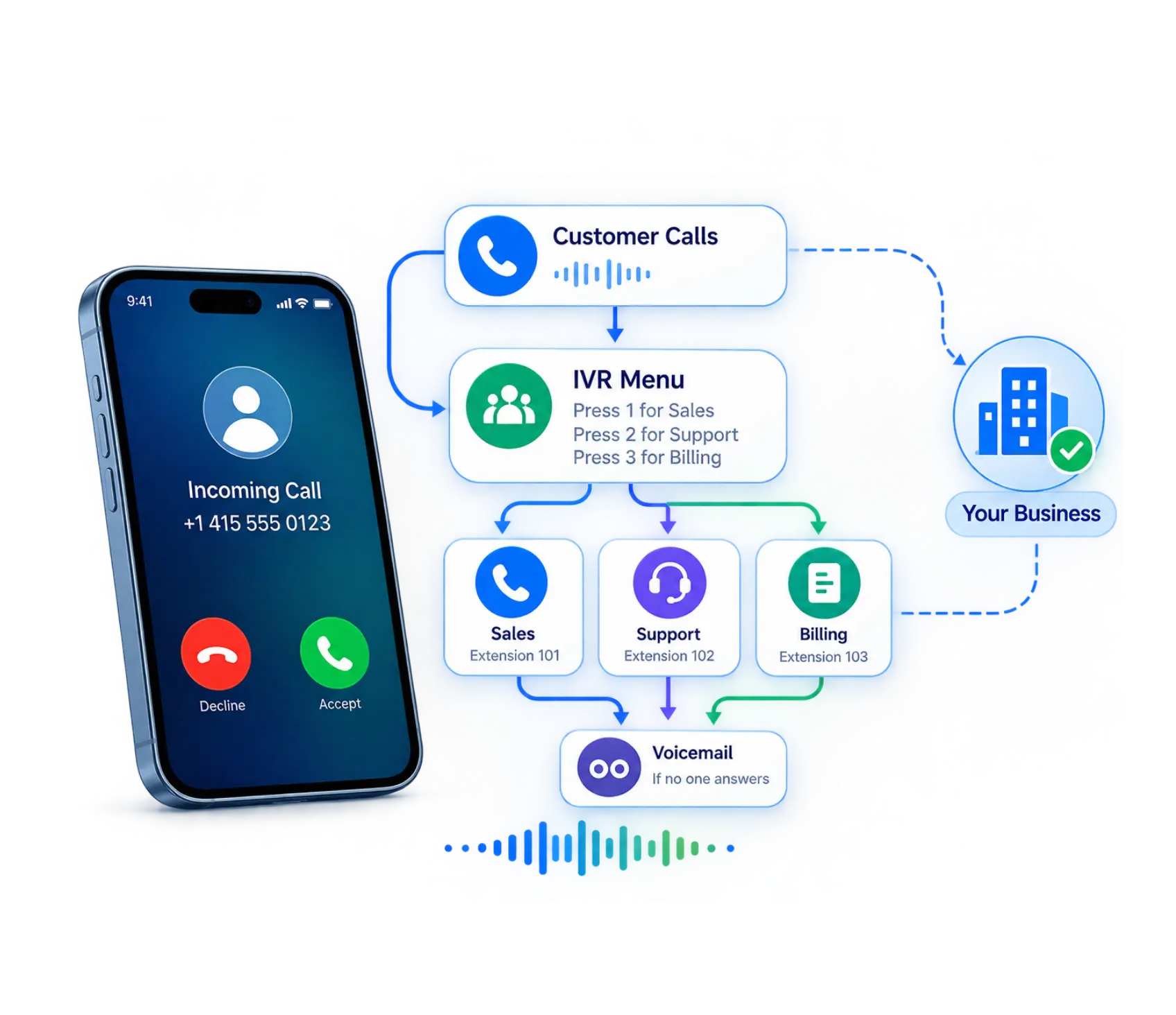
Call flow is the path a call follows from the moment it comes in to the moment it’s resolved, whether that’s a conversation with an agent, a voicemail, or a self-service answer through a menu. It’s essentially the blueprint deciding what happens at every single step of that journey.
A simple setup might just ring one phone and go to voicemail if nobody answers. A more developed one could greet the caller, offer a menu, route based on their selection, check agent availability, and fall back to a queue or another department if the first option isn’t available. Either way, it’s what turns a random incoming call into something structured and predictable, rather than leaving everything up to chance.
This matters more than people realize until it’s missing. Without a defined process, businesses end up with calls landing wherever they happen to land, sometimes the right desk, sometimes not, with no consistency a customer can actually count on.
Working Structure of Call Flow Process
Breaking down a call flow process into its actual working parts makes it a lot easier to understand why some calls feel smooth and others don’t. It’s not magic, it’s just a sequence of small decisions happening in fractions of a second, one after another.
This is how it looks as it passes through its stages:
1→
Call Initiation
A phone rings, the system detects an incoming call, and basic information like the dialed number and caller ID is captured.
2→
IVR greeting or menu
A recorded message or an interactive menu greets the caller. Responses include “Press 1 to speak to sales”.
3→
Route Decision
The call flow process decides the next step in the call flow, depending on caller input, time of day, or some predefined rules.
4→
Availability Check
The system checks to see if the department or agent they are trying to reach is available to take the call at this time.
5→
Connection or queue
Call immediately if there’s someone free. Otherwise, the caller is put into a queue and possibly an estimated wait time is given.
6→
Fallback options
If no one answers after a certain period of time, the call flow process can be configured to pass to voicemail, another department or a call back option, rather than simply looping the phone.
These are all steps that may be as simple or as detailed as a business might need them. A five-person team might only need three of these steps, while a larger call center might have several layers of routing logic stacked on top of each other.
Explore Dialinger Call Queue Management Software
We'd Love to Hear From You
Ready to expand your business globally?
Fill out the form below, and our team will help you choose the perfect number.
Purpose of Call Flow in a Contact Center
The stakes get higher once you’re talking about call flow in a contact center specifically, since volume changes everything. A five-person office can tolerate a slightly clunky process because the numbers are small. A contact center handling hundreds or thousands of calls a day cannot, small inefficiencies multiply fast at that scale.
This structure exists to keep that volume organized without collapsing into chaos. Call flow in a contact center determines how incoming calls get distributed across available agents, how overflow gets handled during busy periods, and how specialized queues, billing, technical support, sales, stay separate instead of blending into one confusing mess.
This is also where reporting becomes genuinely valuable. Well-structured call flow in a contact center generates data on where bottlenecks happen, which routes take too long, and which agents are consistently overloaded compared to others. Without that visibility, a contact center is essentially guessing at problems instead of actually seeing them clearly in the data.
Benefits of a Call Flow System
A properly built call flow system does a lot more than just move calls from point A to point B. The real value shows up in a handful of clear, practical benefits:
Consistency for every caller
Everyone gets routed the same predictable way, instead of depending on who happens to answer the phone that day.
Fewer dropped or lost calls
A solid call flow system accounts for what happens when the first option isn’t available, instead of leaving a caller stranded.
Improved team organization
Staff know exactly what kinds of calls they’re supposed to be taking, instead of having to take random calls and put them in some other category.
Improved customer experience
Calls that land in the right place the first time leave people feeling like the business actually has things together.
Easier scaling
As a business grows, a call flow system can expand with new departments or rules without rebuilding the whole setup from scratch.
None of these benefits require anything exotic, they’re really just what happens naturally once a business stops leaving call handling up to chance and actually designs the process on purpose. The businesses that skip this step tend to notice the gap eventually, usually right around the moment they’ve outgrown whatever informal system got them started in the first place.
Best Practices to Improve Call Efficiency
Building this kind of structure is one thing, but keeping it actually efficient over time takes a bit more intention. A few habits consistently help improve call efficiency without requiring a total system overhaul.
- Keep menus short: Long IVR menus with too many options tend to frustrate callers before they even reach the right place, which hurts call efficiency right from the start.
- Route based on real skill, not just availability: Sending a technical question to whoever’s simply free, rather than whoever’s actually equipped to help, tends to backfire and slow everything down.
- Check call data frequently: Call efficiency is not a plug and play solution, don’t assume that the setup is effective after a few months, take a look at call data frequently.
- Add fallback options everywhere: Every routing decision should have a backup plan. A setup with no fallback for a busy line eventually loses someone who simply gave up waiting.
- Test the actual caller experience: It’s easy to design something on paper that looks fine, but actually calling in and experiencing the menu firsthand tends to reveal awkward gaps worth fixing.
These practices aren’t complicated, but they do require someone actually paying attention rather than setting things up once and never revisiting them again.
Who Actually Needs to Think About This
It’s easy to assume this only matters for massive call centers, but that’s not really accurate. A few situations make this worth genuine attention:
- Any growing business that’s outgrown a single person answering every call and manually deciding where to send it.
- Multi-department companies where sales, support, and billing all need calls to land in different places without confusion.
- Companies that have remote or hybrid workforces and don’t have an office to passively route a call to the appropriate employee.
- Anyone running promotions or seasonal spikes, where call volume jumps unpredictably and the routing needs to hold up under pressure.
None of these situations require enterprise-level infrastructure to address properly. They just require actually thinking through the process on purpose, rather than letting it develop by accident as the business grows.
Common Mistakes That Break a Good Setup
A few recurring issues tend to show up even in businesses that put real thought into their process:
- Overcomplicating the menu: Adding option after option over time until the menu itself becomes the obstacle rather than the solution.
- No regular testing: Something that worked fine a year ago might quietly be broken now, with nobody noticing until a customer complains.
- Ignoring after-hours scenarios: Plenty of businesses design a solid daytime process and completely forget what happens to calls after everyone’s gone home.
- Treating it as a one-time project: Teams change, departments shift, and a routing setup that isn’t revisited periodically eventually stops matching how the business actually operates.
Avoiding these mistakes mostly comes down to treating call flow as something that needs occasional maintenance, not a system you build once and forget about entirely.
Why Dialinger Fits Into This
If you’re looking to build or improve your setup, Dialinger phone IVR feature handles the routing logic at the core of any solid call flow, directing callers to the right place automatically based on the rules you actually need. Paired with automatic call distribution, calls get spread across available agents intelligently instead of piling up on whoever happens to be free.
For businesses running a full contact center operation, Dialinger virtual call center solution brings routing, queueing, and reporting together in one place, while call traffic insights show exactly where things are working well and where they’re quietly falling apart.At the end of the day, call flow is one of those things nobody thinks about until it’s broken. Getting it right doesn’t mean building something complicated, it just means designing the path a call takes on purpose, instead of leaving it to chance and hoping every caller happens to land somewhere useful.
Frequently Asked Questions (FAQs)
What is call flow?
It’s basically the path a call takes from the moment it comes in to the moment it’s actually resolved, whether that’s reaching an agent or hitting voicemail.
How does a call flow process actually decide where to send a call?
It usually runs through a set sequence, greeting, menu selection, availability check, then routes based on whatever rules the business has set up.
Are there simple ways to actually improve call efficiency without a full system overhaul?
Yeah, keeping menus short and reviewing call data regularly go a long way without needing to rebuild anything from scratch.
Why does call flow in a contact center matter more than it would for a small office?
Volume. A five-person team can absorb small hiccups, but a contact center handling hundreds of calls a day can’t, mistakes multiply fast at that scale.